Among the four product groups most often named in discussions of traceability — food, agricultural products, pharmaceuticals and export goods — agricultural products are in the hardest position. Not because the rules are stricter, but because Vietnam's agricultural supply chain was never designed to keep records: it moves fast, it stays flexible, it runs on personal relationships. Traceability demands the opposite — everything must leave a trace, carry a timestamp, and have someone accountable for it.
The 1 January 2027 milestone — the date by which priority product groups must have full traceability — sounds distant, but for a dragon fruit cooperative or a cashew processing facility it is only a few harvests away. And because traceability data is historical data, recorded at the moment an event happens and impossible to reconstruct afterwards, whoever starts late will permanently lack the data for the period before. This is not an obligation anyone can sprint through.
The legal framework has closed
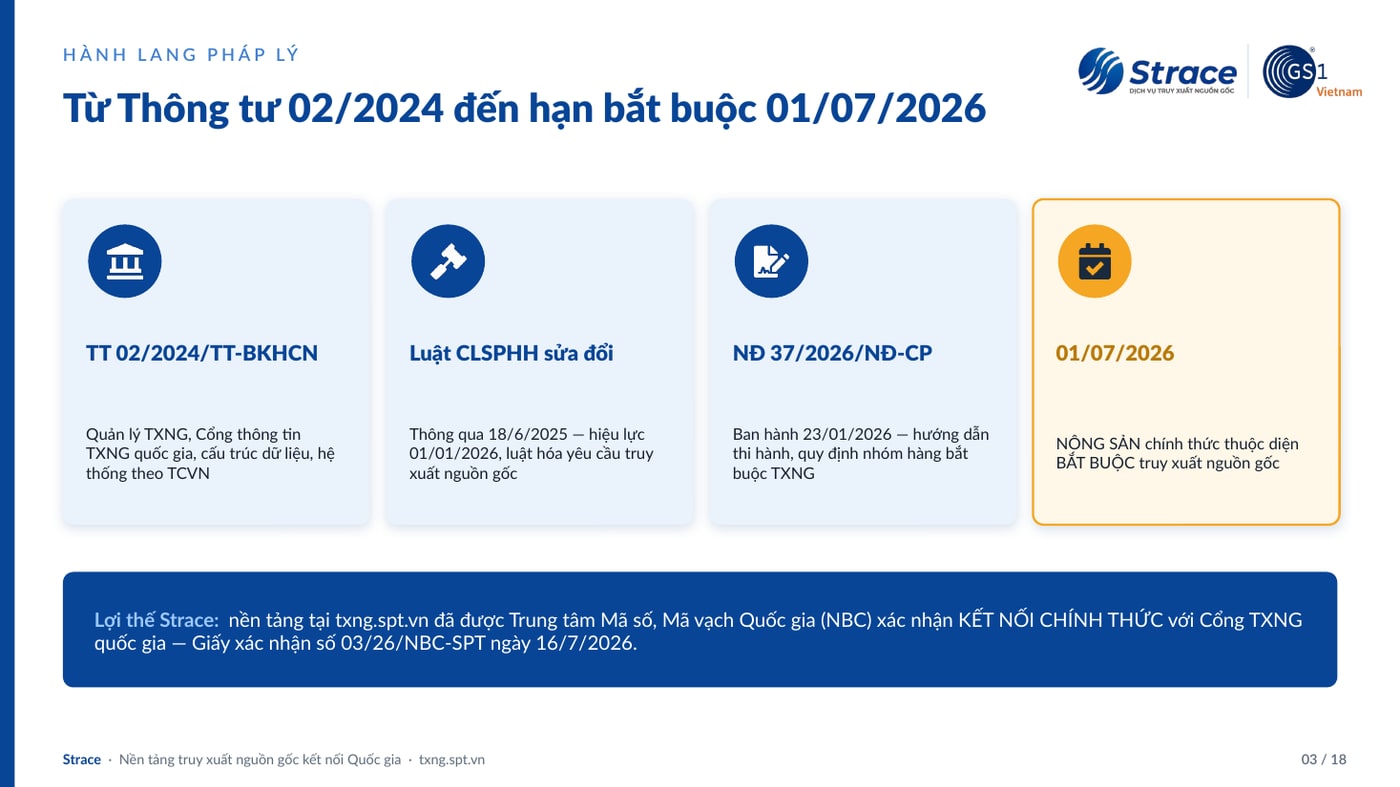
Three instruments shape the picture, and what stands out is that they moved traceability from encouraged to mandatory within two years.
- Thông tư 02/2024/TT-BKHCN (Circular 02/2024/TT-BKHCN) lays the technical foundation: management of product and goods traceability, operation of the national traceability portal, data structures and system requirements under TCVN standards.
- The amended Law on Product and Goods Quality, Luật 78/2025/QH15 (Law No. 78/2025/QH15), passed by the National Assembly on 18 June 2025 and effective from 1 January 2026, writes the traceability requirement into law. From this point on, the traceability stamp is described as a product's "digital passport".
- Nghị định 37/2026/NĐ-CP (Decree 37/2026/ND-CP), issued on 23 January 2026, provides implementing guidance and specifies which product groups fall under mandatory traceability. The obligation to register the connection of a traceability system to the national portal takes effect from 1 July 2026. Agricultural products are formally within the mandatory scope.
One point deserves close reading: the connection obligation has been in force since mid-2026, while the requirement for full traceability only arrives on 1 January 2027. The gap between the two dates is precisely the window in which to clean up chain data before it is measured against the "full" standard.
Anatomy of an agricultural chain: where the data breaks
Take a familiar case: a 12-tonne consignment of mangoes bound for Northeast Asia, moving through five stages, each with its own kind of break.
Cultivation — where records are scarcest
The mangoes come from 40 households, each farming a few sào. Cultivation logs, where they exist at all, live in notebooks or in memory: which round of fertiliser, which pesticide, how many days of pre-harvest interval. This is the stage that determines the value of the entire traceability record, because every food safety question comes back to it in the end — and it is also the stage with the least capacity for digital record-keeping.
Collection — where the data gets mixed
Traders pool produce from many households onto a single truck. One act of pooling and the information about which household, which plot, which harvest date disappears for good. This is the most serious break in the chain and also the least invested in, because the trader is not the party legally accountable for the stamp.
Preliminary processing — where batch codes are created arbitrarily
At the packhouse the produce is washed, graded, heat-treated or irradiated. Batch codes are usually assigned according to each facility's own habit: by date, by shift, by customer name. Two facilities code in two different ways, and when the records are joined, no one can reconcile them.
Packing — where new codes are not linked to old ones
Cartons are labelled with new codes for shipping. Without a rule linking the carton code to the processing batch code, and the processing batch code to the list of households, the chain is broken even though every stage holds data of its own.
Distribution and export — where the questions get asked
The only stage with a clear incentive, because the importer asks directly — but the answer depends entirely on the four stages before it.
Traceability does not fail at the weakest stage — it fails at the joints between stages. A business can digitise its own plant superbly and still end up with a broken chain, if the inbound batch codes cannot talk to the outbound ones.
What to record, and who is accountable for entering it
The question "which software" always gets asked first, but the question that decides success or failure is "who enters the data, and at what moment".
| Stage | Minimum data to record | Person accountable for entry |
|---|---|---|
| Cultivation | Plot/household identifier, variety, planting date, log of input materials, harvest date, yield | Farming household or cooperative technical officer |
| Collection | Collection batch code, list of contributing households and the volume from each, date and time, vehicle | Collection officer |
| Preliminary and further processing | Production batch code, links to the inbound collection batch codes, processing steps, test results | Production shift manager |
| Packing | Packing unit code, link to the production batch code, expiry date, pack specification | Packing team |
| Distribution and export | Outbound batch code, customer, shipping documents, storage conditions | Warehouse and logistics department |
The third column is the hard part. The lead enterprise in the chain has systems, staff and incentives; the farming household and the trader do not. Any roadmap that ignores that reality collapses in month three, when the logbooks start going blank.
The real cost does not sit in the software
Most small businesses ask about technology costs straight away. That puts the focus in the wrong place: the real effort is distributed almost the opposite way to intuition.
- Changing record-keeping habits. Persuading 40 households to keep cultivation logs consistently and at the right moment — the most labour-intensive and longest-running item on the list, and a human task rather than a software one.
- Standardising batch codes and procedures. Agreeing one coding scheme across the whole chain, rewriting operating procedures, retraining the production teams.
- Testing and quality records. Traceability is only worth something when the testing milestones travel with it.
- Technology. The item talked about most, and usually the smallest share of total effort.
The practical implication: do not start by choosing a platform. Start by mapping your own chain and identifying who enters the data at each link. With nothing yet to record, even the best tool produces only an empty data store behind a handsome interface.
The export ticket: the market asked before the law did
There is a way of framing this that makes the problem easier to live with: for export-oriented businesses, traceability is not a newly incurred compliance cost but the formalisation of a requirement customers have imposed for years.
- The European Union has applied the "one step back — one step forward" principle in its general food law for many years. More recently, the regulation on deforestation-free products pushes the requirement down to the plot itself, calling for the geographic coordinates of the place of production for groups such as coffee, rubber, cocoa and timber.
- Japan and South Korea control pesticide residues very tightly and routinely request cultivation records when an alert is raised. A flagged consignment that cannot be traced back to the plot has consequences beyond that consignment: the supplier as a whole is placed under enhanced inspection.
- Buyers' voluntary standards — good agricultural practice schemes, retail chain standards — have long required cultivation records and batch-level recall capability.
Businesses that already export seriously tend to hold most of the data they need; it simply sits scattered across spreadsheets, paper books and email. The work is to connect and standardise it, not to build it from scratch. Businesses selling only on the domestic market should read the 2027 deadline as an opportunity — the records built to comply with Vietnamese law are the same records that open the door to exporting later.
Choosing a platform: the first criterion is interoperability
Once there is data to record, the platform question becomes a legitimate one. In its role as an analysis and advisory unit for member businesses, Times Zones recommends screening in this order: (1) can it connect to the national traceability portal; (2) does its data structure follow the standards; (3) does it support data entry at the upstream end of the chain on simple devices; (4) and only then, the interface. The first criterion is an eliminating one: a closed, self-contained stamp system that displays nothing but self-declared company information, however handsome, does not satisfy the connection registration obligation in force since 1 July 2026.
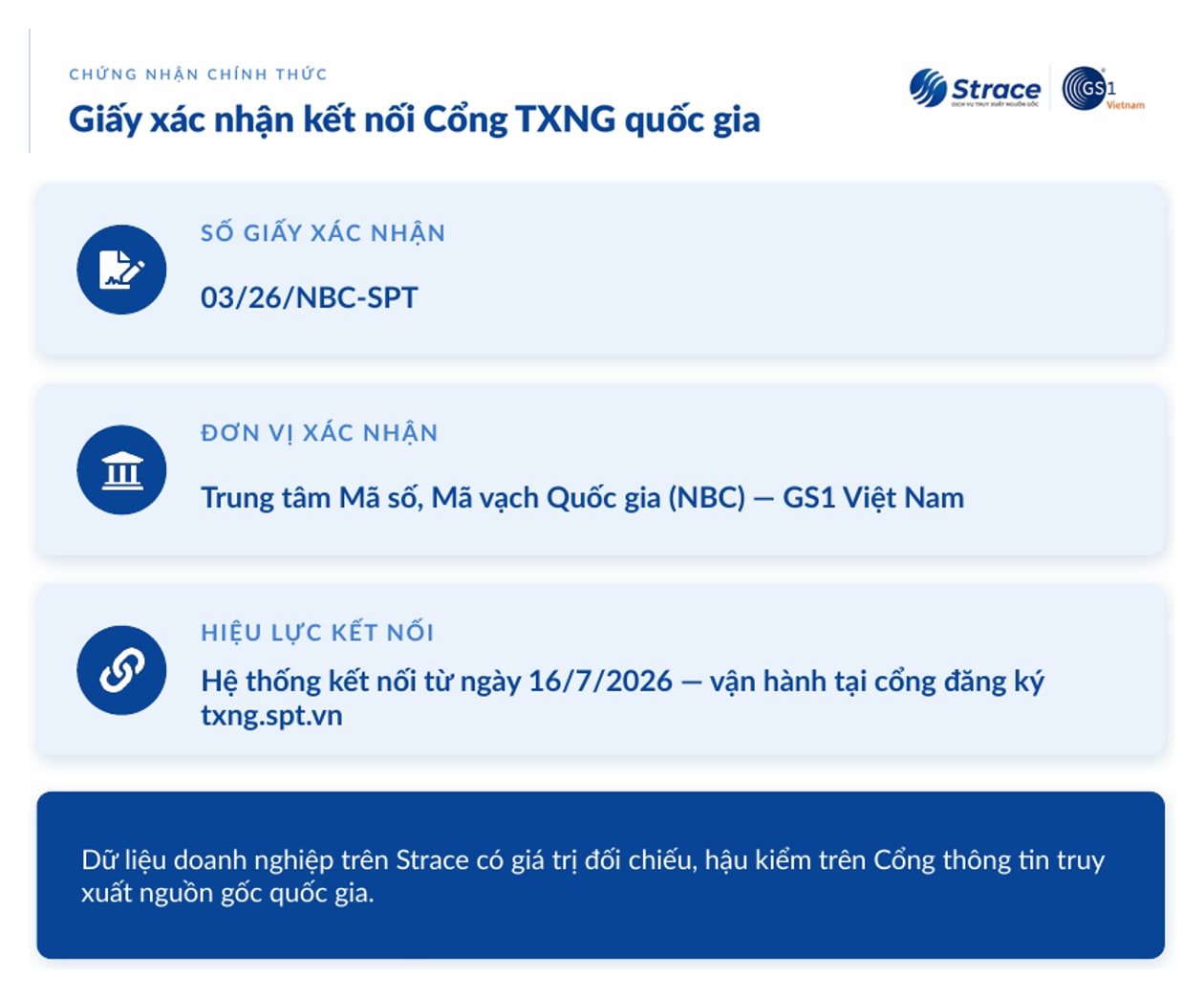
Among the platforms currently available, Strace — the traceability platform developed by SPT (Saigon Postel), with its registration portal at txng.spt.vn — is a case worth examining against this criterion: Strace has been confirmed by the National Barcode Center (NBC) as officially connected to the national product and goods traceability portal, under Confirmation Certificate No. 03/26/NBC-SPT dated 16 July 2026. The platform also runs a training and implementation support programme (Strace Academy) and provides documentation in three languages — Vietnamese, English and Chinese.
The limits of that observation should be stated plainly: a platform already interoperating with the national portal answers the question "is the infrastructure valid", not the question "does my chain have data to put into it" — the second one still belongs to the business. Times Zones is not an agent, partner or distributor of Strace; interested businesses can register directly at the txng.spt.vn portal, and should compare it against other solutions using the same set of criteria.
A six-step roadmap for cooperatives and small businesses
With limited resources, the most effective approach is to go deep on a single product line rather than thin across the whole catalogue.
- Map the real chain, not the ideal one. List the parties actually involved, traders and outsourced processing facilities included; mark every point where data is pooled or lost.
- Pick one pilot product line — preferably the highest-value line, or one already being exported — and a limited growing area, for example 10 households rather than all 40.
- Standardise batch codes before digitising. Agree one coding rule for the whole chain, and one rule for linking codes between stages. This step can be done on paper, and it must be finished before anything goes into any system.
- Assign data entry responsibility to named individuals, with a mandatory moment of entry: immediately at harvest, immediately at the end of the shift. Responsibility stated in general terms means no one does it.
- Choose a platform against the criteria above and register the connection to the national portal. Run the paper books and the digital system in parallel for at least one season, to cross-check and expose the gaps.
- Rehearse a traceback. Pick a released stamp code at random and require the team to trace it back to the list of households, the plots and the cultivation logs within four hours. This is exactly what a regulator or an importer will ask for when something goes wrong.
If only one thing can be done this quarter, choose steps 1 and 3: they cost nothing in technology, need no budget approval, and determine the quality of everything that follows. Those who finish before the end of 2026 will enter 1 January 2027 with real data; those who skip them will enter the same date with a handsome system and an empty data store.
Compliance roadmap advisory with Times Zones
Times Zones works alongside member businesses to review their supply chains, identify the points where data breaks, standardise batch codes and build a compliance roadmap matched to their actual scale — with no affiliation to any platform vendor. Contact info@timeszones.space; for information on registering with the Strace platform, see the txng.spt.vn portal directly.