In most conversations with early-stage founders, traceability sits at the bottom of the priority list — after the product, after sales channels, after cash flow. The familiar argument: “sell first, paperwork later.” That argument is right about sequence and wrong about cost. Traceability is not an administrative step bolted onto the end of the chain; in substance it is a way of recording production data. And data can only be recorded correctly at the moment it is generated. After that, everything is reconstruction — expensive, uncertain, and in more than a few cases impossible.
This piece is written for founders in the Times Zones member network, particularly those in agricultural produce, food, medicinal herbs and export goods — sectors that have already entered the scope of mandatory regulation. Times Zones writes as an analysis and compliance-roadmap advisory firm, and does not represent any platform vendor.
The legal framework has closed off the “later” option
What changed over the past two years is not market expectation but legal obligation — on a specific timetable.
| Milestone | Substance |
|---|---|
| Thông tư 02/2024/TT-BKHCN (Circular 02/2024/TT-BKHCN) | Governs traceability of products and goods; establishes the national traceability portal; sets data structures and system requirements under TCVN (Vietnamese national standards). |
| Luật 78/2025/QH15 (Law No. 78/2025/QH15) amending the Law on Product and Goods Quality | Passed 18 June 2025, effective 1 January 2026 — writes traceability requirements into statute. The traceability label is described as a product’s “digital passport”. |
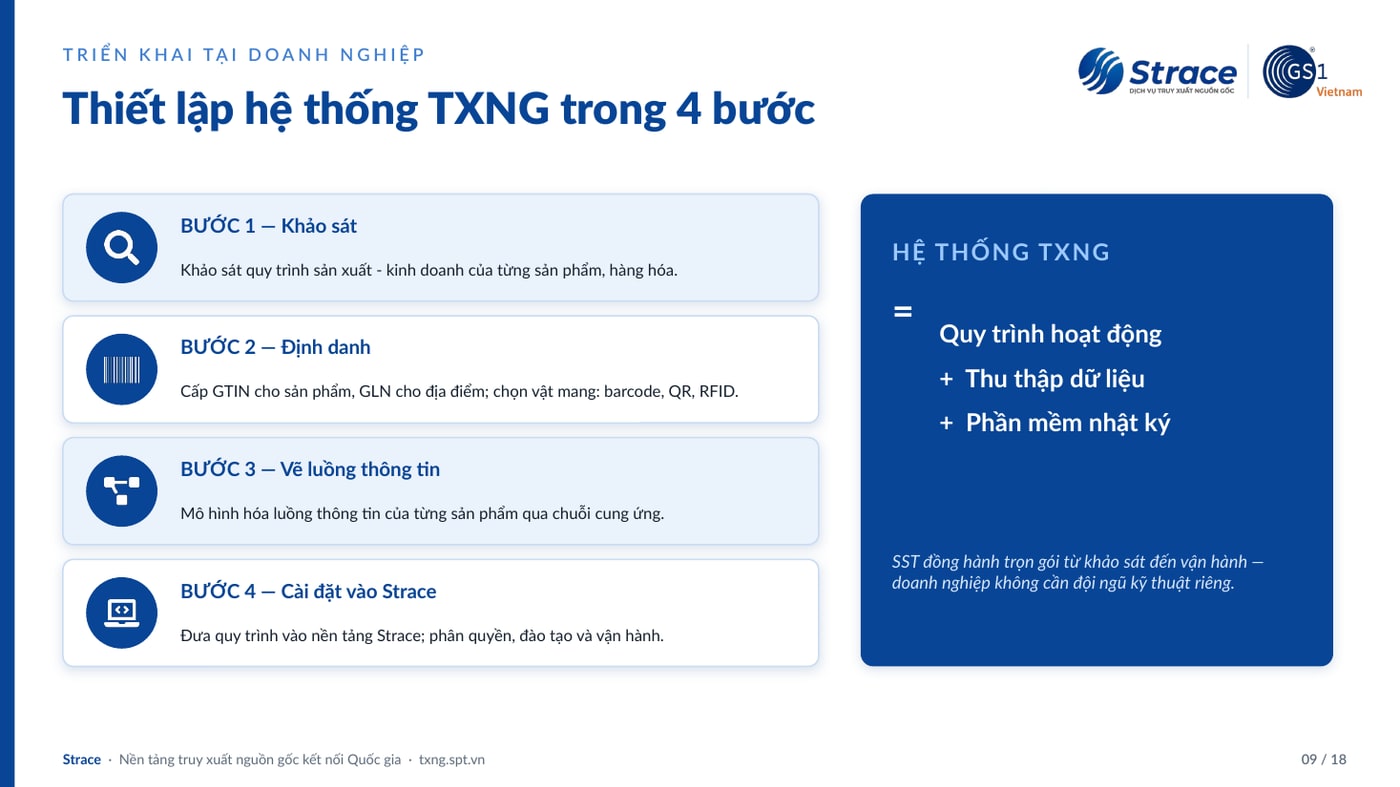
| Nghị định 37/2026/NĐ-CP (Decree 37/2026/NĐ-CP, 23 January 2026) | Specifies the product groups subject to mandatory traceability. The obligation to register a traceability system connection with the national portal takes effect from 1 July 2026. Agricultural produce falls formally within the mandatory scope. |
| From 1 January 2027 | Priority groups — food, agricultural produce, pharmaceuticals — must have full traceability. |
Read that table as a planner, not as a news reader. For a startup expecting a commercial product within the next 12–18 months, the 1 January 2027 milestone falls inside the life cycle of the first batch. Which means the way data is recorded has to be ready before that first batch leaves the plant.
The blank page: an advantage large companies have to pay to buy back
A company that has been operating for years and then rolls out traceability must deal with the whole legacy: handwritten notebooks on the production floor, scattered spreadsheets kept by individual staff, batch codes assigned by habit and by shift, suppliers who never kept adequate records, and tens of thousands of units already in the market that nobody can assign to a batch. Most of the time and budget in enterprise traceability projects goes not to software but to cleaning up and standardising historical data.
A startup carries none of that. A first-year company can decide from batch 001 onward: one unique code per batch, tied to the input supplier, the production date and shift, test parameters, and the delivery point. The marginal cost of doing it right from the start is close to zero — you have to record the data to operate in any case. The expensive part is not the recording; it is the re-recording.
A young company owns an asset that large companies have to buy back with cash: a blank page.
Consider the opposite situation, familiar to many members working in processed agricultural products. A company has sold a packaged dried product line for two years through provincial distributors, e-commerce platforms and one small importer. Now an overseas customer asks for traceability records covering batches already delivered, or a regulator asks it to prove the source of the raw material after a quality complaint. If the packaging carries only an expiry date and no batch code, everything stalls at the first step. Three kinds of cost follow, in ascending order:
- People and time. Reconstruction consumes exactly the people who matter most — the founder, the production manager — for weeks, at the moment the company needs them to sell.
- Opportunity. An export order, a supermarket-chain contract, a funding round may slip or be lost because the documentation is not ready in time. This is usually the largest item, and the one almost nobody accounts for.
- Irrecoverable. If a recall becomes necessary, a company that cannot trace batches has to recall everything instead of only the affected batch. For a startup, that can be the difference between an incident and an ending.
Designing the recording process from the first production batch
Strip away the terminology and traceability is just four questions every batch must be able to answer: where the inputs came from, how and when it was processed, where the finished goods went, and who was responsible at each step. A startup of fewer than 20 people can handle this cleanly:
- One unique batch/lot code, assigned by rule rather than by habit. The rule is written down and does not depend on who is on shift. The batch code is printed on the packaging, not only on the warehouse slip.
- Record at the point where the event occurs, not in a weekend catch-up. Data entered three days late is estimated data. A phone on the production floor is usually enough.
- Bind inputs to the supplier at the goods-receipt slip. For smallholder sources, identify at minimum the growing area and the person delivering — far easier to set up when you first start buying than after two years.
- Follow the standard data structure from the outset. Thông tư 02/2024/TT-BKHCN already specifies data structures and system requirements under TCVN. Inventing your own data fields means converting all of it later.
- Test it with a traceback drill. Pick a batch code already sold, at random, and require the full journey to be reconstructed within two hours. Failing that, the system is not ready — labels notwithstanding.
Two under-counted benefits: operating data and the investment file
The most common classification error is putting traceability in the marketing budget. When that happens, the label is only a QR code leading to a brochure page with farm photos and a few lines of commitment — attractive, but it traces nothing. Placed correctly, a traceability system is the cleanest source of operating data a small company will have, because it forces data to be recorded at the right moment and against the right object. From that same dataset, a founder can answer: which batches sell through faster and what is different about them; where losses concentrate; which suppliers are stable on specifications; which channel is holding stock close to expiry. These are expensive decisions, and most startups are currently making them on instinct.
On the funding side, early-stage investors do not diligence an agri-food startup on spreadsheet margins. They look at operating risk and the ability to scale. Traceability shows a transparent supply chain — where the raw material actually comes from, and how dependent the business is on a single supplier. It shows clean operating data: a company that can export batch history in real time cuts weeks off diligence compared with one assembling it from photographs of notebooks. And for priority product groups it removes from the file a legal risk with a fixed date — the kind always discounted into valuation, even when it is rarely said out loud.
The four most repeated mistakes
- Building your own system. The hard part is not the batch data table; it is the obligation to connect to the national traceability portal, keeping to the standard data structure as regulations change, and maintaining the system after whoever wrote it leaves. Over the full life cycle this is almost always the most expensive option.
- Choosing a solution that does not interoperate with the national portal. Many labelling systems are closed: scanning the code opens an information page stored by the label vendor itself, with no data connection to the national product traceability portal. Given the legal milestones above, that is an investment at risk of having to be redone. The question to put to every vendor: has the system been confirmed as connected to the national portal, and under which document?
- Attaching traceability to marketing rather than operations. The consequence: labels, no data, and failure at the first real inspection.
- Waiting for a large order before starting. Large orders usually come with short delivery deadlines. Implementing under deadline pressure is the surest route to a patchwork system.
One reference point in the market
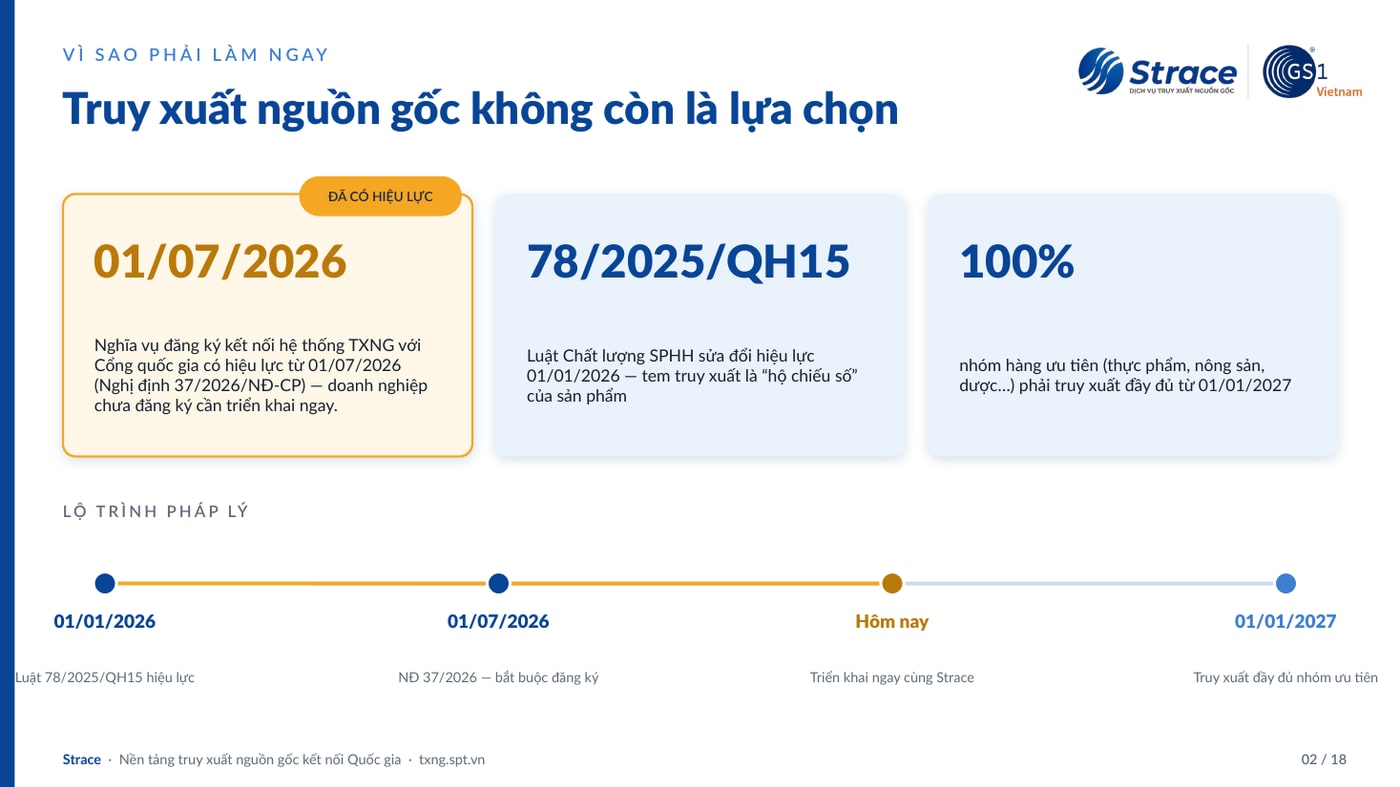
Among the solutions currently available, Strace is a traceability platform developed by SPT (Saigon Postel), with its registration portal at txng.spt.vn. What is notable from an analytical standpoint: Strace has been confirmed by the National Barcode Center (NBC) as officially connected to the national product and goods traceability portal — Confirmation Certificate No. 03/26/NBC-SPT dated 16 July 2026. The platform also runs a training and implementation-support programme (Strace Academy) and provides documentation in three languages — Vietnamese, English and Chinese — which matters for export-oriented businesses.
Times Zones presents this as market analysis, not a purchase recommendation, and has no agency or distribution relationship with the platform’s developer. Companies can research and register directly at txng.spt.vn, after comparing several options against three criteria: interoperability with the national portal, a TCVN-compliant data structure, and implementation-support capability.
A three-phase roadmap for startups under 20 people
Intended for companies with one to three product lines and no ERP.
Phase 1 — Standardise internally, before buying any solution
- Draw the actual supply chain on a single page: from supplier to end buyer, and who holds what information at each step.
- Issue a batch-coding rule and apply it to the next batch — no retrofitting, no waiting for perfection.
- Agree a single supplier list and identifiers for material-sourcing areas, including smallholder sources.
- Determine which product group the company falls into under Nghị định 37/2026/NĐ-CP, and which milestone applies to it.
Phase 2 — Digitise and connect
- Select a platform against three mandatory criteria: confirmed connection to the national portal, a TCVN-compliant data structure, and real implementation support.
- Pilot on one product line, across three consecutive batches, before extending.
- Train the people who actually record the data on the floor and in the warehouse — not managers who then pass it on.
- Run a traceback drill once before calling it done.
Phase 3 — Put the data to work
- Bring traceability data into the monthly operating report: losses by step, stability by supplier, turnover by channel.
- Package the traceability file as a standard component of the B2B sales pack and the investment file.
- Review periodically as regulations change, particularly ahead of 1 January 2027.
These three phases do not require a bigger organisation. They require an early decision — and for a startup, an early decision is the cheapest asset you have.
Talk to Times Zones about your compliance roadmap
Times Zones works with members on the part that gets the least airtime: determining which category the company falls into under current regulation, designing a data-recording process suited to its actual scale, and building a criteria set for assessing the solutions on the market. We advise on the roadmap; we do not sell the platform.
Founders who are interested can write to info@timeszones.space to arrange a conversation, or look up the information and registration procedure directly at the txng.spt.vn portal.