A food business discovers counterfeit goods bearing its own name on sale in online marketplaces. The owner opens the filing cabinet and pulls out the trademark registration certificate: complete, still valid, filed under the correct product class. But when asked whether the batch out there was made by his company, on what date, and from raw materials grown in which region, he cannot answer with data. He can only answer with words.
That is the gap between two layers of protection, and many Vietnamese businesses have only one of them. A registered trademark protects the name. Traceability protects the chain — the physical journey from raw material to shelf. Miss either one, and counterfeits still have room to live.
A trademark protects the name; traceability protects the chain
These two instruments are usually filed in separate drawers: trademarks belong to legal, traceability belongs to production. That division creates a blind spot — the two answer complementary sets of questions, not interchangeable ones.
| The practical question | Registered trademark | Traceability system |
|---|---|---|
| Who has the right to use this commercial sign? | Provides legal grounds | No answer |
| Which batch and which date does the product in the customer's hand belong to? | No answer | Answers it |
| Which growing area supplied the raw material for this batch? | No answer | Answers it |
| Quality incident: how much has to be recalled? | No answer | Answers it, batch by batch |
| Are there grounds to require a marketplace to take counterfeit listings down? | Answers it | Supplies supporting evidence |
| Did the goods on the market actually leave our plant? | Not enough to prove it | Answers it |
Counterfeiters work precisely in the empty cells. With a trademark alone, a business has the right to take legal action but must go through the labour of proving batch by batch that the goods are fake. Conversely, with a traceability system but no registered trademark, someone else can register that very name first — and then, however complete the data may be, it will not stop the company from having to change its name in the market it built.
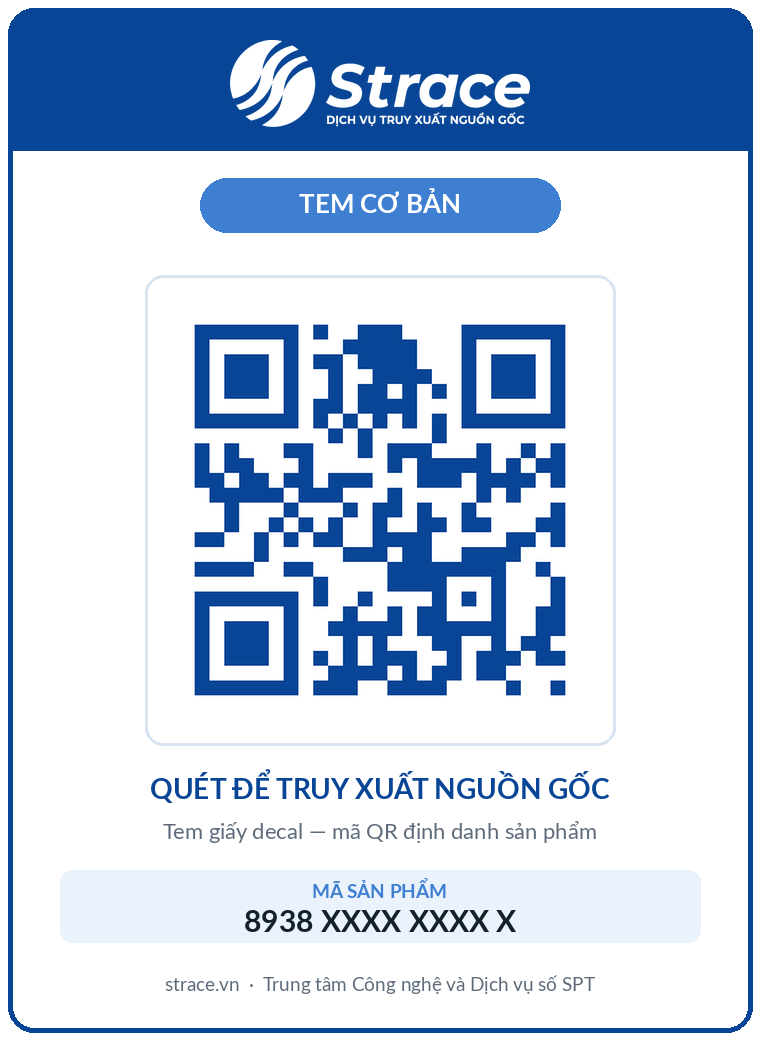
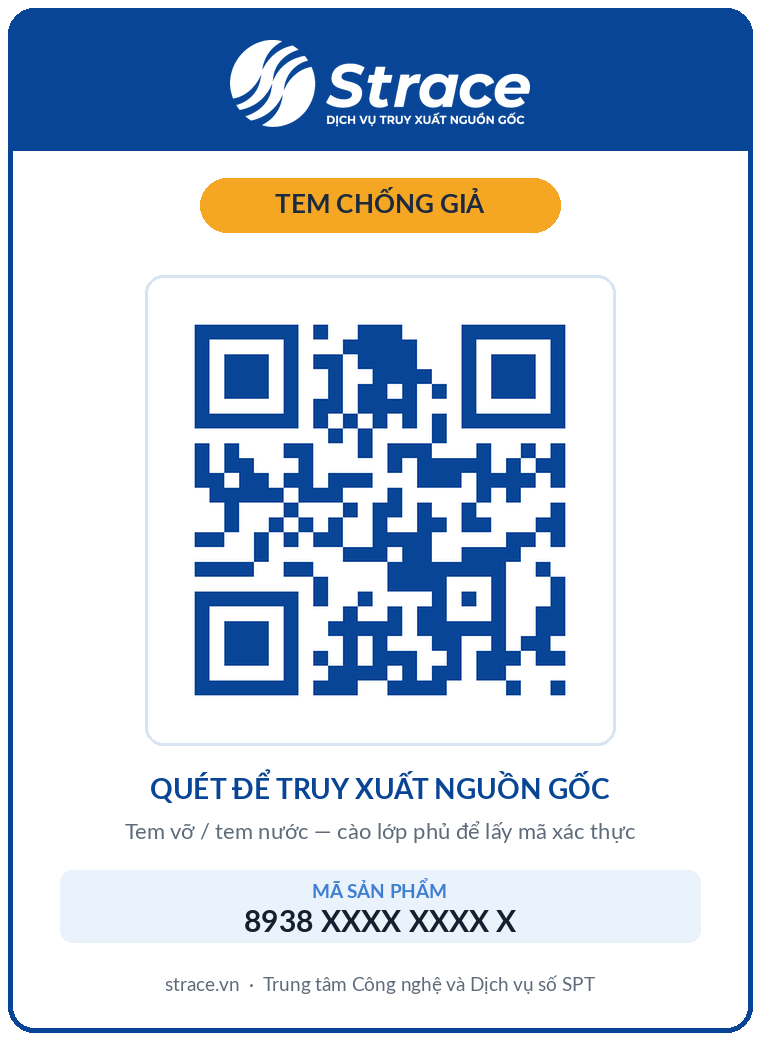
Counterfeits do not attack the product, they attack trust
The goal of a counterfeit is not to make a product identical to the original, but to make the buyer believe it is the original during the three seconds spent standing in front of the shelf. Every anti-counterfeiting technology revolves around those three seconds.
The common reflex is to apply a QR label issued by the company itself; scanning it opens a web page with a logo and the words "genuine product". This mechanism has three specific weaknesses:
- Code copying. One genuine label is photographed and reprinted in bulk, so thousands of counterfeit units carry the same valid code. If the system does not count scans and does not bind each code to a single unit of goods, every scan returns "genuine".
- Parallel systems. The counterfeiter builds its own lookup page and issues its own codes. The consumer scans, sees a result and a professional-looking interface, and concludes that the goods are legitimate — nobody checks what authority that page actually has.
- No independent point of reference. Both the genuine and the counterfeit data sit on servers controlled by whoever issued the label. Consumers, distributors and regulators have no third place to cross-check against.
The third weakness is the root; the first two are only consequences. A closed, self-contained label system, however sophisticated its encryption, is still certifying itself.
Why interoperability with the national portal changes the problem
What distinguishes the interoperable model is that the data does not stop inside the company's own system. It is pushed to the national traceability portal for products and goods — a reference point controlled neither by the business nor by the counterfeiter.
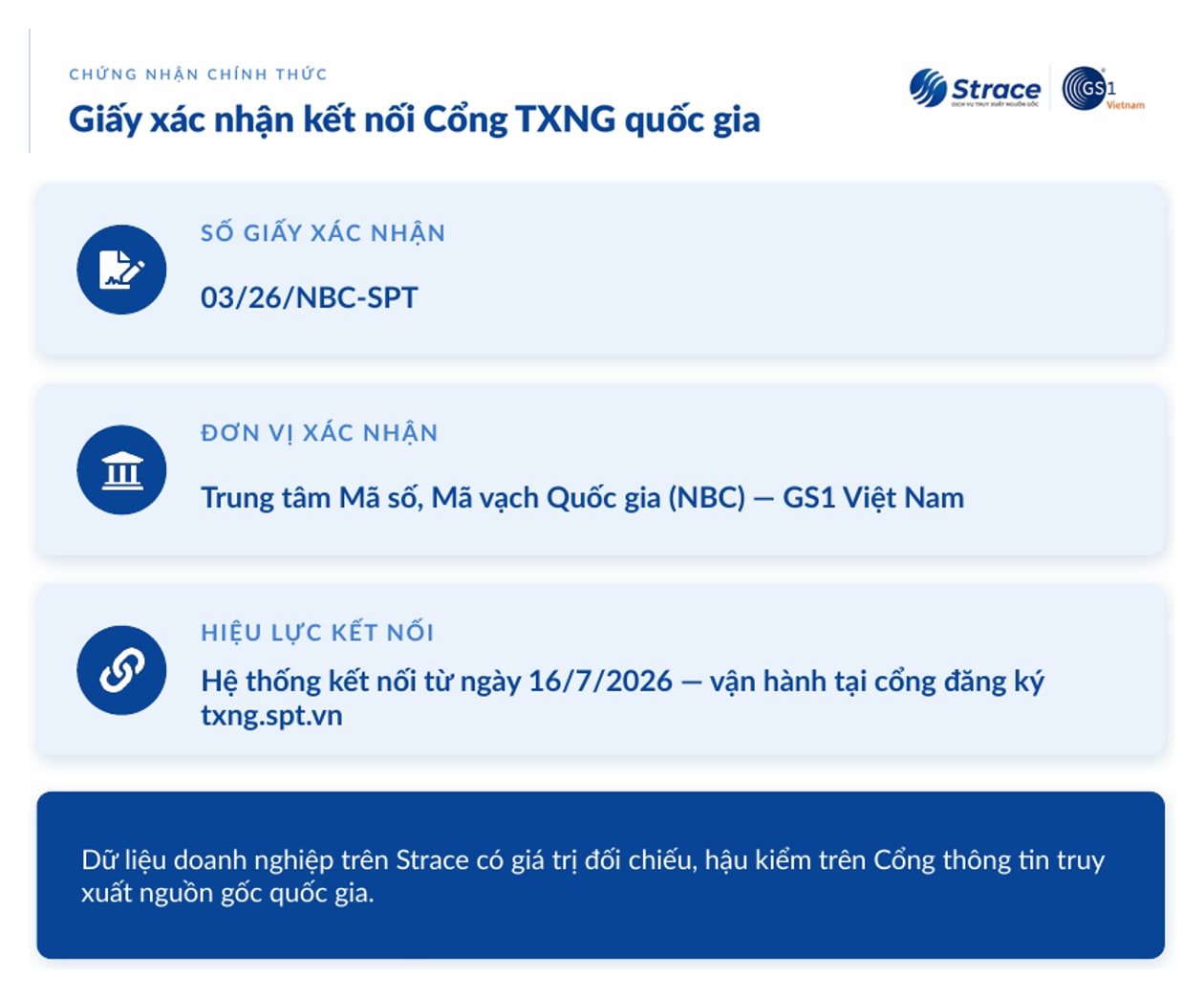
In the current market, one of the platforms already confirmed for this step is Strace, a traceability platform developed by SPT (Saigon Postel), with its registration gateway at txng.spt.vn. The National Barcode Center (NBC) has confirmed that Strace is officially connected to the national traceability portal under Confirmation Certificate No. 03/26/NBC-SPT dated 16 July 2026. The platform also runs a training and deployment support programme (Strace Academy) and provides documentation in three languages: Vietnamese, English and Chinese.
We set out these facts as an analyst, not as a vendor. The technically notable point is this: when the traceability record sits in a system beyond the reach of either side, counterfeiting no longer stops at the printing stage. A counterfeiter can copy the image of the label, but cannot create the corresponding record in a place where it has no right to write. That makes forgery considerably harder — stated at its true level, not impossible. No solution eliminates counterfeiting entirely; a good system only pushes the cost of faking above the profit and shortens the time to detection.
The legal framework has moved from encouragement to obligation
Where traceability used to be a marketing choice, from 2026 it is a legal obligation for many product groups. Four milestones to keep in mind:
- Thông tư 02/2024/TT-BKHCN (Circular 02/2024/TT-BKHCN of the Ministry of Science and Technology) governs the management of product and goods traceability, the national traceability information portal, data structures and system requirements under TCVN standards — the technical foundation.
- The amended Law on Product and Goods Quality, Luật 78/2025/QH15, passed by the National Assembly on 18 June 2025 and effective from 1 January 2026, has written the traceability requirement into law.
- Nghị định 37/2026/NĐ-CP (Decree 37/2026/NĐ-CP), issued on 23 January 2026, provides implementing guidance and specifies the product groups subject to mandatory traceability. The obligation to register the connection between a traceability system and the national portal takes effect from 1 July 2026. Agricultural produce is formally within the mandatory scope.
- From 1 January 2027, the priority groups — food, agricultural produce and pharmaceuticals — must have full traceability.
A traceability label is often described as a product's "digital passport". The comparison is worth noting for one reason: a passport has value not because of the cover, but because of the data system behind it and because a third party is responsible for issuing it.
For a business with more than a year left before the 2027 deadline, this is not a procurement problem but a problem of standardising internal processes. The hard part is not the software; it is whether the plant floor records the right batch code.
When something goes wrong: testimony and data are two different kinds of evidence
Dealing with counterfeits on the market
When counterfeit goods surface, the first thing the authorities need is a basis for telling them apart. With interoperable traceability records, proving that "this batch does not appear in our production output data" becomes a lookup rather than a chain of argument. The trademark gives the right to demand enforcement; traceability data supplies the evidence that gets the demand acted on quickly.
Quality complaints and product liability
Without standardised batch codes, a business is left either denying everything or accepting responsibility for everything. With batch codes, it can identify which stage the incident occurred at and which batch is affected, and answer with a specific scope — which protects the brand better than any press release.
Protecting geographical indications and certification marks
This is the point many agricultural businesses overlook. A geographical indication protects the link between a product and a geographical area, yet that link is the hardest thing to prove when it is usurped. Traceability data recording raw materials by growing area, producing household and harvest date is precisely the operational evidence behind an intellectual property right that otherwise exists only on paper. At that point the two layers do not merely complement each other: one feeds the other with evidence.
Batch recall, the real test of the system
Suppose a business is told that an incoming batch of raw material has a problem. The question: how long does it take to determine which finished batches used that material and where they are now? Without a system, the recall has to be broad because the boundary is unknown, and the cost of over-recalling is usually many times the cost of building the system, before counting the reputational damage. With standardised batch codes, the company can delimit the scope and notify proactively; that very proactivity strengthens the brand.
Three trade-offs worth stating plainly
- Data discipline is a real cost. A traceability system is only as good as the data entered into it. Wrong data is more dangerous than no data, because it creates evidence against the company itself in a dispute. Before choosing a solution, make sure the production team has a recording process reliable enough to carry it.
- The level of disclosure has to be designed. Traceability does not mean publishing everything. Supplier lists, material consumption norms and cost structures are competitive information. Tiering is needed: what is shown to consumers, and what is reserved for regulators and partners within the chain.
- Platform portability. Before signing with a provider, ask one question: in what format can my traceability data be exported, and can I take it elsewhere? That answer matters more than most of the features on the brochure.
A package of work to do in parallel, not in sequence
The common mistake is to handle the trademark first, think about traceability a few years later, and then discover that the two identification systems do not match. In preparing for the 2026 and 2027 milestones, the following five tasks belong in a single plan:
- Review and complete the trademark portfolio. Not only the main commercial name, but also sub-brand and product line names, distinctive packaging, and foreign-language versions of the name if you export. Check that the registration covers the product classes you actually trade in — the wrong class is a common error, and it surfaces only when you need to enforce the right.
- Define the traceability unit. Down to what level: production batch, carton, or individual retail unit? This decision governs every downstream operating cost and should not be left to the software vendor to make for you.
- Standardise batch codes and input records. A consistent coding rule, recording forms on the plant floor, a named owner for each stage. This is the most labour-intensive part and the least technological.
- Connect the traceability system to the national portal. A business can register directly at txng.spt.vn, or assess other solutions against the same criteria: is the connection to the national portal confirmed, can the data be exported, and is there training and operational support?
- Align identifiers across both layers. The trademark name in the intellectual property file and the product name declared in the traceability system must match character for character. It sounds trivial, but this is exactly where records diverge at the moment they are needed as evidence.
Done in parallel, the two layers lock into each other: the name established by law, the chain proven by data, each layer supporting evidence for the other.
Talk to Times Zones about your compliance roadmap
Times Zones approaches this subject as an analyst and adviser to its member businesses, not as an agent or distributor for any platform. Our work sits upstream of the technology: reviewing intellectual property files, determining which traceability obligations apply to a given product group under Nghị định 37/2026/NĐ-CP, designing batch coding rules, and building a roadmap that meets the 1 July 2026 and 1 January 2027 deadlines.
On intellectual property services — trademark registration, protectability searches, infringement handling — details are available on the Times Zones Intellectual Property page. On the Strace platform, businesses can find out more and register directly at txng.spt.vn.
To discuss a compliance roadmap, get in touch at info@timeszones.space.