In just two years, product traceability in Vietnam has moved from an encouraged, marketing-driven activity to a legal obligation with fixed deadlines, mandatory product groups and a data infrastructure operated by the State.
For small and medium enterprises — particularly in agricultural produce, food, pharmaceuticals and export goods — this is not one more administrative formality. It reaches into how batch/lot codes are assigned, how data is recorded on the factory floor, and even how terms are negotiated with foreign partners. This article reconstructs the 2024–2027 timeline, identifies where the real difficulty lies, and proposes a 90-day checklist.
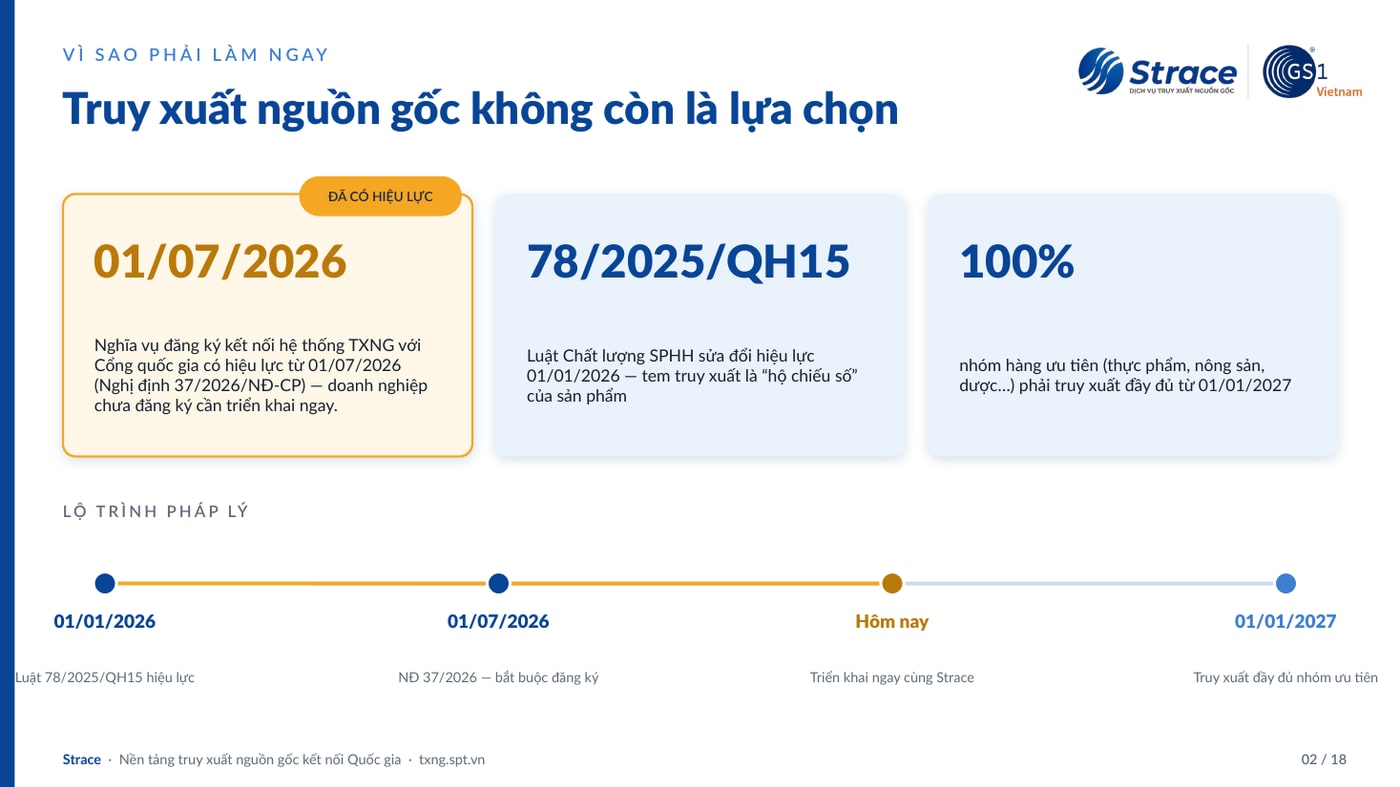
The timeline: four decisive milestones
| Milestone | Legal document | Core content | Implication for businesses |
|---|---|---|---|
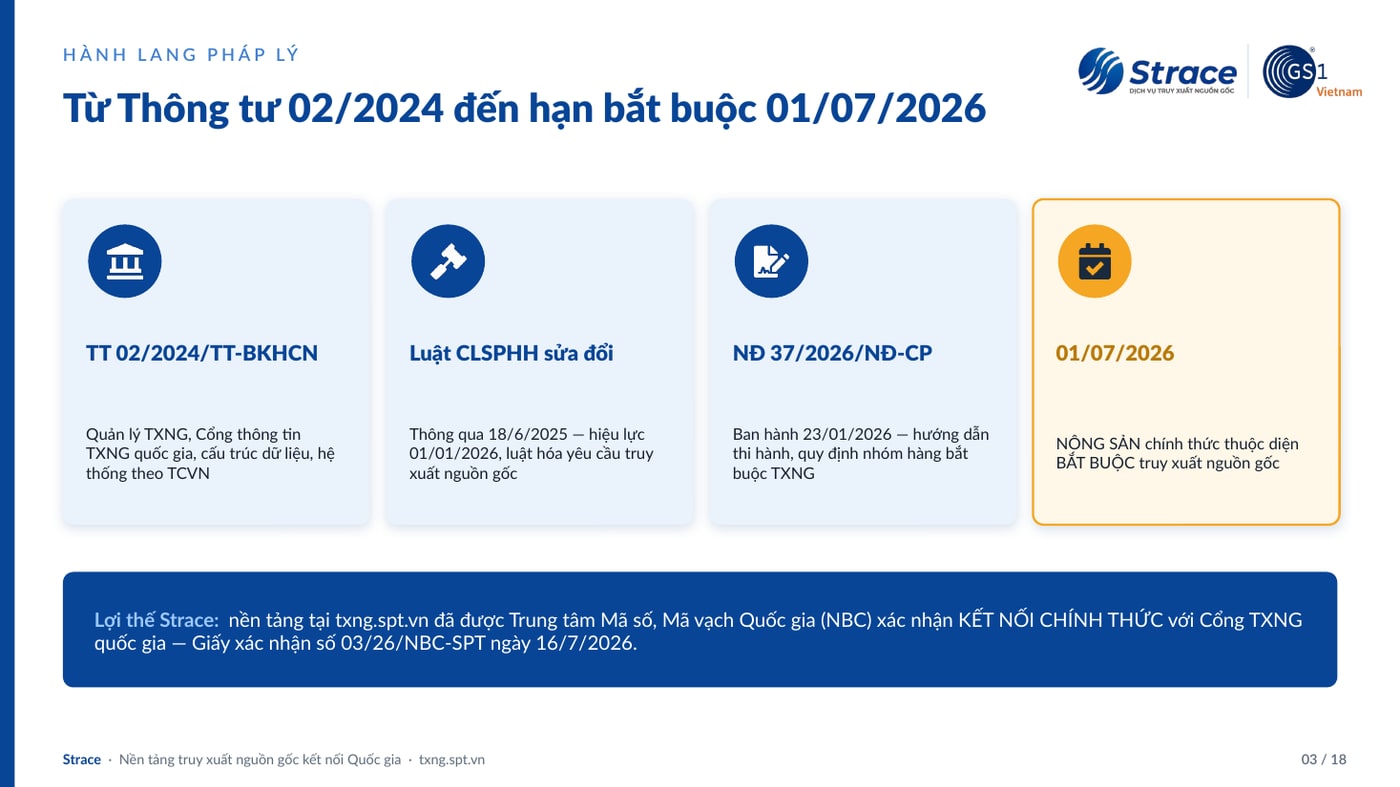
| 2024 | Thông tư 02/2024/TT-BKHCN (Circular 02/2024/TT-BKHCN) | Management of product and goods traceability; the national traceability portal; data structured to TCVN standards | Traceability data must follow a common structure — no more one format per organisation |
| Passed 18 June 2025 Effective 1 January 2026 |
Luật 78/2025/QH15 — amended Law on Product and Goods Quality | Traceability requirements written into statute; the traceability label described as a product's "digital passport" | Traceability leaves the marketing budget and enters the legal-compliance column |
| Issued 23 January 2026 Connection obligation from 1 July 2026 |
Nghị định 37/2026/NĐ-CP (Decree 37/2026/NĐ-CP) | Defines the product groups subject to mandatory traceability — agricultural produce is formally included; the obligation to register the connection between an enterprise's traceability system and the National Portal takes effect on 1 July 2026 | The question is no longer "are we doing it" but "are we connected yet" |
| 1 January 2027 | Full-traceability deadline | Priority groups — food, agricultural produce, pharmaceuticals and others — must have full traceability | Data must cover the entire chain, not stop at final packaging |
Read vertically, the direction is unmistakable: technical standardisation → statutory obligation → mandatory connection → full-coverage requirement. Each step tightens the one before it, and the intervals between them keep shortening. Whoever missed step one will find step three hard to complete on time.
From "encouraged" to "obligatory": three changes in substance
The burden of proof reverses
Previously, when an incident occurred, the regulator or the customer had to prove that something was wrong with the product. Once traceability becomes a legal obligation, the burden shifts to the enterprise: it must prove where the product came from, which stages it passed through and who was responsible at each stage — and prove it immediately, from data already on hand, rather than going back through notebooks three weeks later.
This reversal matters more than any level of penalty: with a complete record, you can isolate the right batch and contain the damage; without data, a broad recall becomes unavoidable, because there is no way to demonstrate that the rest is safe.
What is regulated is the data, not the label
This is the most widely misunderstood point. The QR label is only the interface. What the regulations care about is the data system behind it: whether the identifiers follow the standard, whether the data conforms to TCVN, whether it can connect to the National Portal, whether a finished product can be traced back to its raw materials.
Risk shifts from quality to documentation
A batch that meets every quality requirement can still carry legal risk if its traceability record does not. Many traditional manufacturers are used to controlling physical quality but not data quality. For exporters the risk doubles: a number of import markets already require digitised traceability records, and a system that falls short of the domestic standard is unlikely to be reusable for export documentation.
Why "connecting to the National Portal" is the hard part
Applying labels is the easy part. The difficulty lies in the obligation that takes effect on 1 July 2026 under Nghị định 37/2026/NĐ-CP: registering the connection between the enterprise's traceability system and the national product and goods traceability portal. Three layers of difficulty stack up:
- The identifier layer. Product codes, batch/lot codes and production-facility codes must follow a unified standard so that the national portal can read them. Anyone using self-invented codes of the "L2608-A" kind has to remap all of them — a data-review exercise, not an IT project.
- The data layer. The structure must follow the TCVN standards set out in Thông tư 02/2024/TT-BKHCN. An internal spreadsheet, however complete, does not become standard-compliant traceability data on its own.
- The interoperability layer. The system must be able to transmit data to the national portal and keep doing so continuously. This is where most "all-in-one QR label" offerings stop: a closed database that scans through to the vendor's own page, with no route out to the national portal.
If you remember only one thing: the legal value of traceability lies in the data link to the National Portal, not in the label. A label with no connection is a cost, not compliance.
Which product groups feel the pressure first
Nghị định 37/2026/NĐ-CP identifies the mandatory product groups, and agricultural produce is formally included. The 1 January 2027 milestone raises the bar again, to full traceability for the priority groups: food, agricultural produce, pharmaceuticals and others. The pressure therefore falls in roughly this order:
- Fresh and lightly processed agricultural produce — the heaviest burden, because the chain is fragmented: many growers, many collection points, and a batch code that only comes into existence late. Tying data back to the growing area is an organisational problem, not a software one.
- Processed food — a more concentrated chain, but a finished product combines many inputs; "full" traceability pushes data requirements onto the suppliers themselves.
- Pharmaceuticals and functional foods — already accustomed to strict batch records; what is usually missing is digitisation and interoperability.
- Export goods — pressure from both the domestic and the foreign side, but also the biggest beneficiary: one system built properly serves both.
A typical situation: a fruit cooperative buys from many households, packs by day, and applies a QR label that scans through to an introductory page. Asked to trace one specific batch, it cannot say whose produce that batch contained — because the batch code is created at packing, after the goods have already been mixed together. The problem lies in the recording procedure at the collection point, not in the software. Without fixing the procedure, no system will mean anything.
Five misconceptions that cost small businesses
- "A QR label means we have traceability." A self-printed QR pointing at a product introduction page is a communications tool. Standard-compliant traceability requires standardised identifiers, TCVN-conformant data and the ability to interoperate with the national portal.
- "We'll do it when an inspection comes." The most time-consuming work is not buying software but cleaning up historical data and fixing the recording procedures on the factory floor. That part cannot be shortened with budget.
- "Small businesses are surely exempt." The Decree defines scope by product group, not by company size. If a product falls into a mandatory group, the obligation applies regardless of scale.
- "The software vendor will handle everything." They handle the infrastructure and the connection. No one else can decide, on your behalf, what a batch unit is and who is responsible for entering the data.
- "Once it's done, it's done." Traceability is a continuing obligation, updated batch by batch. A system that is deployed and then abandoned is more dangerous than none at all, because it produces a misleading record.
Reading the solutions market: which criteria come first
The market spans everything from plain label printing to full supply-chain management platforms. As an analysis and advisory unit working with member businesses, Times Zones recommends four criteria as the first filter, before any discussion of interface or features:
- Evidence of connection to the National Portal — not a marketing claim, but a written confirmation carrying a reference number and a date, issued by the competent authority.
- Data standards — is the data organised to the TCVN standards required by Thông tư 02/2024/TT-BKHCN, or to the vendor's own structure?
- End-to-end backward traceability — can it model raw material → semi-finished product → finished product, or does it only attach a label at the final stage?
- Data ownership — if you change vendor after three years, can the historical data be exported? Few ask this question, and that is exactly where long-term lock-in begins.
Measured against the first criterion, one instructive example is Strace — a traceability platform developed by SPT (Saigon Postel), with its registration portal at txng.spt.vn. Strace has been confirmed by the National Barcode Center (NBC — Trung tâm Mã số Mã vạch Quốc gia) as officially connected to the national product and goods traceability portal, under Confirmation Certificate No. 03/26/NBC-SPT dated 16 July 2026. The platform provides training and implementation support (Strace Academy) and documentation in three languages, VI/EN/ZH — a meaningful factor for exporters.
Times Zones cites this example in its capacity as an analysis unit, not as an agent or distributor; businesses can review it and register directly at the portal named above. The point to take away is methodological rather than about any one name: a certificate of connection to the national portal is evidence worth requiring from any vendor.
Trade-offs worth weighing
A system that interoperates with the national portal demands markedly more data discipline than a closed label solution: codes must be standardised, entries must be made at the right moment, and errors are hard to correct retroactively. In return, the resulting record serves both domestic compliance and export negotiations. A local label scheme deploys quickly and barely disturbs existing procedures, but by the mandatory-connection deadline it will almost certainly have to be rebuilt from the ground up — the true cost of choosing "fast" sits in that rebuild.
The 90-day checklist: six things to do
The order below follows one principle: whatever cannot be bought with money goes first.
- Days 1–10 — Define the scope. Match your product catalogue against the mandatory product groups under Nghị định 37/2026/NĐ-CP. The output must be explicit: which products are mandatory, and which fall under the full-traceability requirement from 1 January 2027.
- Days 10–25 — Define the batch unit. Settle what a batch/lot means for each product line: by production run, by day, or by material-sourcing area; at which stage the batch is formed, and who records it. Get this wrong and everything downstream is wrong with it.
- Days 20–40 — Audit the data you already have. Inventory the notebooks, spreadsheets, accounting software and supplier records; sort them into three levels: usable — fragmented — never collected. The third group is the real workload.
- Days 35–55 — Standardise the identifiers. Map internal codes onto standardised identifiers: production-facility code, product code, batch/lot code. The most laborious stage, and one that cannot be shortened.
- Days 50–75 — Select a system and register the connection. Apply the four criteria above; require the written confirmation of connection to the national portal; pilot one product line first rather than rolling out the whole catalogue at once.
- Days 70–90 — Run a backward-traceability drill. Pick a batch code that has already been sold, at random, and ask operations to trace it: which supplier the raw material came from, which day and which shift it was produced on, and who it was delivered to. Set an explicit time target — under two hours, for example. Failing the drill means the system is not ready, however polished the software looks.
Ninety days is not enough to finish, but it is enough to know where you stand ahead of 1 January 2027.
Compliance-roadmap advisory with Times Zones
Times Zones works alongside member businesses on the part that gets discussed least: the stage before the software is chosen — determining the mandatory scope, defining the batch unit, auditing data gaps, building a roadmap around the legal deadlines, and preparing the criteria for evaluating vendors. This is analysis and advisory work, independent of any platform.
Businesses wishing to discuss a compliance roadmap can contact info@timeszones.space. For the Strace platform mentioned in this article, businesses can review it and register directly at the txng.spt.vn portal.